
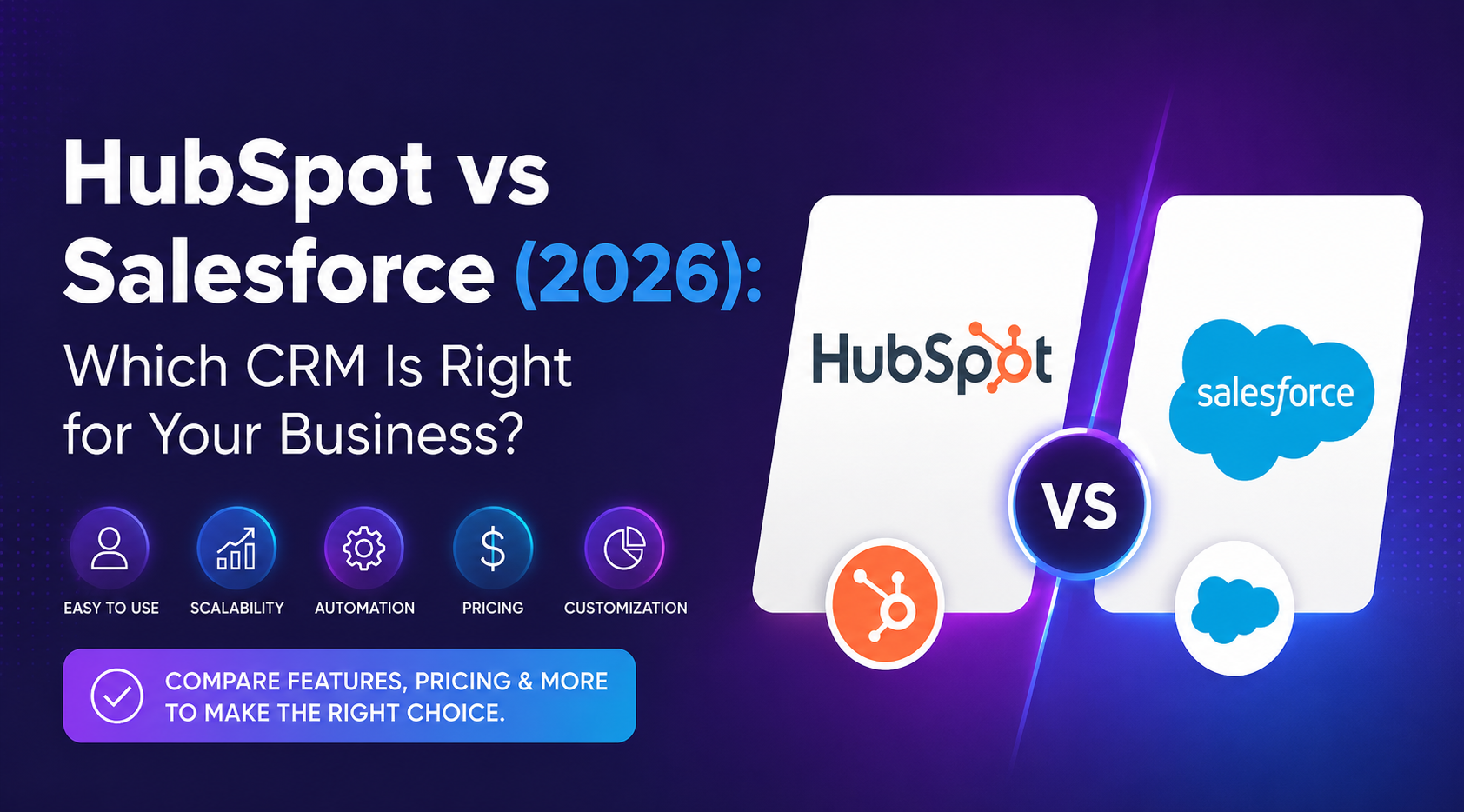
Choosing between HubSpot and Salesforce is one of the biggest CRM decisions a business can make. Both platforms are powerful, but they’re built for different types of organizations. The right choice depends on your company size, growth plans, budget, technical resources, and business processes.
If you’re looking for a CRM that’s easy to use, quick to implement, and brings marketing, sales, service, and operations together, HubSpot is often the better choice. If your business requires extensive customization, complex enterprise workflows, and dedicated CRM administrators, Salesforce remains one of the most powerful enterprise platforms available.
| Feature | HubSpot | Salesforce |
|---|---|---|
| Ease of Use | Intuitive interface with fast adoption | Powerful but requires more training |
| Implementation | Weeks | Often several months |
| Marketing & Sales | Fully integrated platform | Multiple clouds and add-ons |
| Customization | Excellent for most businesses | Extremely flexible for enterprise |
| Reporting | Easy to build dashboards | Highly advanced enterprise reporting |
| Administration | Low maintenance | Often requires dedicated administrators |
| Total Cost | Lower overall ownership | Higher with customization and add-ons |
| Best For | Startups, SMBs & Mid-Market | Large Enterprises & Complex Organizations |
HubSpot offers one of the most user-friendly CRM experiences available. Sales, marketing, and customer service teams can start using the platform quickly with minimal training.
Most businesses can implement HubSpot in a matter of weeks rather than months, helping teams achieve value much sooner.
HubSpot combines CRM, Marketing Hub, Sales Hub, Service Hub, CMS Hub, Commerce Hub, and Operations Hub into one connected ecosystem.
Businesses typically spend less on implementation, administration, maintenance, and third-party integrations compared to more complex CRM platforms.
HubSpot scales with growing businesses while remaining easy to manage as teams expand.
Salesforce offers virtually unlimited customization options for organizations with highly specialized workflows and business processes.
Large organizations can build complex automation, approval processes, security models, and custom applications.
Salesforce’s AppExchange provides thousands of integrations, extensions, and enterprise applications.
Large multinational organizations often choose Salesforce for its extensive enterprise capabilities and governance features.
Winner: HubSpot
Quick implementation, affordable pricing, and minimal administration make HubSpot ideal for startups.
Winner: HubSpot
Businesses benefit from faster adoption, lower costs, and integrated marketing and sales functionality.
Winner: HubSpot (Most Cases)
Growing businesses gain enterprise-grade automation without enterprise-level complexity.
Winner: Depends on Requirements
Organizations with highly customized processes may benefit from Salesforce, while enterprises seeking simplicity and unified operations increasingly choose HubSpot.
HubSpot provides a modern, intuitive interface that encourages user adoption. Salesforce offers significantly more flexibility but comes with a steeper learning curve.
HubSpot implementations typically take weeks, while Salesforce implementations often require several months depending on complexity.
HubSpot delivers native marketing automation tightly integrated with CRM data. Salesforce often requires additional products for a complete marketing solution.
Both platforms offer powerful sales automation, forecasting, pipelines, and reporting. HubSpot emphasizes simplicity, while Salesforce prioritizes flexibility.
HubSpot Service Hub integrates seamlessly with the CRM, while Salesforce Service Cloud provides extensive enterprise support capabilities.
HubSpot makes reporting easy for business users. Salesforce offers deeper analytics and reporting for highly customized enterprise environments.
HubSpot supports custom objects, workflows, automation, and integrations suitable for most organizations. Salesforce remains the leader for highly complex enterprise customization.
While license pricing varies depending on editions and users, total cost extends beyond subscription fees.
HubSpot generally requires:
Salesforce often includes additional costs for:
For many businesses, HubSpot provides a lower total cost of ownership over the long term.
HubSpot is an excellent choice if you:
Salesforce may be the better option if you:
Neither platform is universally better. HubSpot excels in usability, speed of implementation, and lower ownership costs, while Salesforce offers unmatched customization for enterprise organizations. The right choice depends on your business requirements.
In many cases, yes. While licensing varies, HubSpot generally has a lower total cost of ownership because it requires less administration, fewer customizations, and fewer third-party applications.
Yes. Businesses regularly migrate from Salesforce to HubSpot while preserving contacts, companies, deals, activities, custom properties, and historical data. A properly planned migration minimizes downtime and maintains data integrity.
For most growing businesses, HubSpot offers the best balance of functionality, ease of use, automation, scalability, and affordability.
Yes. HubSpot Enterprise includes advanced automation, custom objects, permissions, reporting, APIs, and integrations that support many enterprise organizations without unnecessary complexity.
Revenue systems, crafted on HubSpot. Implementation, onboarding, migration, integration and managed services for the US, Australia, New Zealand & India.